
menu

Emergency Tarping Service in Chicago – 24/7 Roof Protection Within 90 Minutes

When a storm tears through your roof, every minute counts. Our emergency tarping service stops water damage in its tracks with immediate dispatch, industrial-grade materials, and crews ready around the clock to protect Chicago homes and businesses.

Slider Image 1
Slider Image 2
Slider Image 3
Slider Image 4
Slider Image 5
Slider Image 7
Slider Image 8
Slider Image 9
Slider Image 10
Slider Image 11

Why Chicago Roofs Need Emergency Tarping Fast

Chicago weather does not wait. When Lake Michigan storms blow in with 60 mph gusts or sudden hail pummels your shingles, a compromised roof becomes a ticking clock. Water does not pool on the surface. It finds the smallest gap in your decking, saturates your insulation, drips into your drywall, and spreads through your framing. In six hours, a small leak can ruin ceilings, buckle hardwood floors, and turn your attic into a breeding ground for mold.

The freeze-thaw cycles that define Chicago winters make this worse. Water that seeps into cracks during a rainstorm freezes overnight, expanding and splitting your decking wider. By morning, what was a small breach becomes a gaping hole. Emergency roof tarp installation is not cosmetic. It is immediate damage control.

You need a temporary roof covering service that arrives before the next wave of rain, before your belongings are soaked, before your insurance claim gets complicated. Storm damage roof tarping buys you time to assess the full scope of the problem, schedule permanent repairs, and prevent a $5,000 leak from becoming a $30,000 interior restoration nightmare.

Chicago's unpredictable spring storms and winter ice dams mean roof failures happen without warning. When your roof fails at 2 a.m., you need 24 hour roof tarping, not a voicemail. You need a crew that knows how to secure a tarp on a steep pitch in 30-degree wind, not someone who shows up three days later when the damage is already done.

Why Chicago Roofs Need Emergency Tarping Fast
How We Secure Your Roof During a Crisis

How We Secure Your Roof During a Crisis

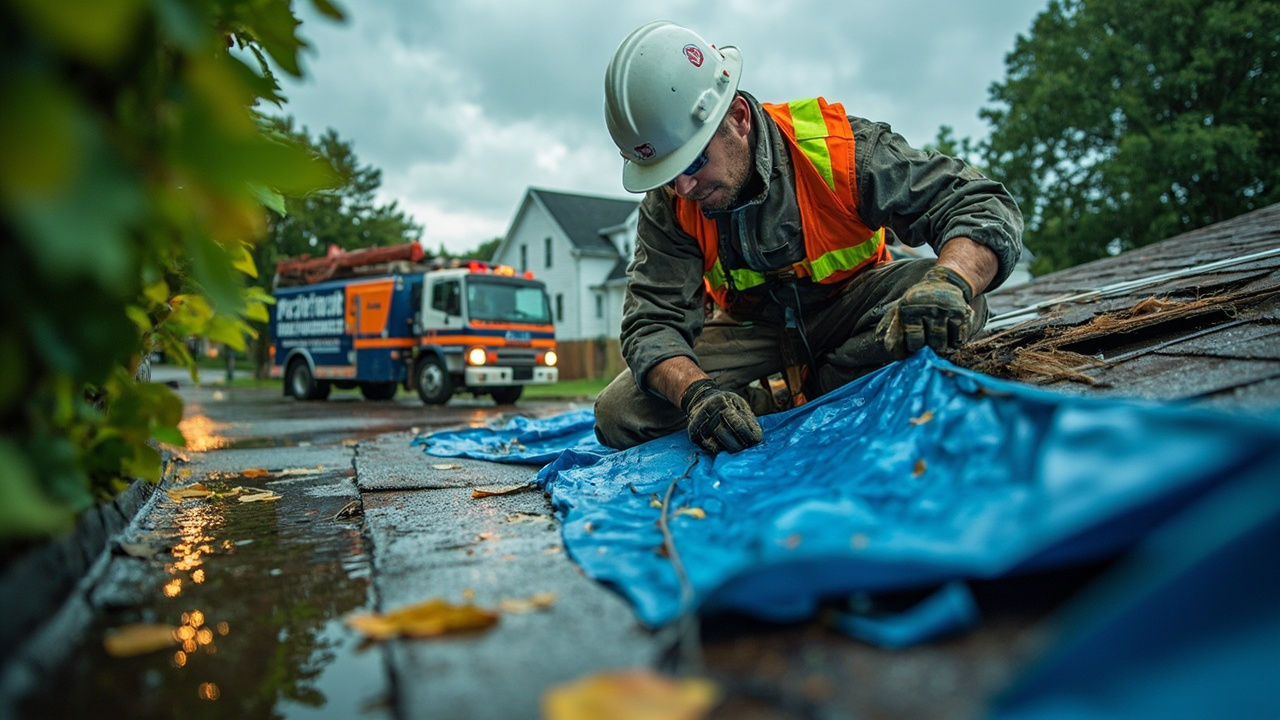
Most tarping jobs fail because the crew uses residential-grade materials or does not anchor properly. We use heavy-duty polyethylene tarps rated for high winds, not the blue plastic you buy at a hardware store. Our tarps have reinforced grommets every 18 inches, and we anchor them with corrosion-resistant fasteners that dig into your decking without creating new leak points.

Our process starts with a rapid damage assessment. We locate every compromised area, clear debris, and dry exposed decking before securing the tarp. If your shingles are torn off but your underlayment is intact, we layer the tarp to create a watershed that channels water away from vulnerable seams. If your decking is cracked or missing, we install plywood bracing first to create a stable substrate. Tarps that sag or billow let water pool and eventually seep through. We tension every edge and use sandbag weights on flat sections to prevent wind lift.

We also photograph the damage before we cover it. This documentation is critical for your insurance adjuster. If you file a claim three days after a storm and your roof is already tarped, the adjuster needs proof of what happened. We provide timestamped images that show the initial damage, the materials we used, and the full scope of our urgent roof tarping work.

Our crews carry ladder stabilizers, fall protection harnesses, and industrial spotlights for night work. We do not cut corners because we are working in the dark or in bad weather. We secure your roof the same way whether it is 2 p.m. on a sunny Tuesday or 2 a.m. during a thunderstorm.

What Happens When You Call for Emergency Tarping

Emergency Tarping Service in Chicago – 24/7 Roof Protection Within 90 Minutes
01

Immediate Dispatch and Assessment

When you call, we dispatch a crew immediately. No waiting for morning. No callbacks. We ask for your address, the type of damage you are seeing, and whether water is actively entering your home. Our dispatcher sends the closest available crew, typically within 90 minutes in the Chicago metro area. While the crew is en route, we walk you through temporary interior measures like moving furniture and placing buckets to minimize damage until we arrive.
02

Damage Containment and Tarp Installation

Once on site, we clear debris, assess structural stability, and dry any exposed decking with industrial blowers if conditions allow. We measure the damaged area and cut tarps to overlap by at least 24 inches on all sides. We anchor the tarp using batten strips along the ridge and eaves, then secure the sides with fasteners driven into solid decking. Every seam is sealed to prevent wind-driven rain from infiltrating. The installation typically takes 45 to 90 minutes depending on roof pitch and damage extent.
03

Documentation and Next Steps

Before we leave, we photograph the completed tarp installation and provide you with a detailed damage report. This includes notes on what we found, what materials we used, and recommendations for permanent repairs. We coordinate with your insurance company if needed and schedule a follow-up inspection within 48 hours to check tarp integrity. Emergency tarping is temporary, but it gives you breathing room to plan the right repair without rushing into a bad decision under stress.

Why Chicago Property Owners Trust Us in a Crisis

When your roof is torn open and rain is pouring into your home, you do not have time to vet contractors. You need someone who answers the phone, shows up fast, and does the job right. Patriot Roofing Chicago has been securing storm-damaged roofs across the Chicago metro for years. We know how Lake Michigan wind patterns create uplift on north-facing slopes. We know how ice dams form along the eaves of Chicago bungalows. We know which neighborhoods have clay tile roofs that shatter in hail and which have flat commercial membranes that split in extreme cold.

Our crews are trained in fall protection and OSHA safety protocols. We carry liability insurance that covers both the emergency tarping work and any incidental damage that might occur during installation. You will not find us scrambling to rent equipment or improvising with the wrong materials. Our trucks are stocked with tarps in six sizes, fasteners rated for high winds, plywood sheeting, and battery-powered tools that work in any conditions.

We also understand Chicago building codes. If your roof damage is severe enough to require a permit for repairs, we help you navigate that process. If your home is in a historic district like Old Town or Pullman, we know the restrictions on materials and colors. We do not just slap a tarp on your roof and disappear. We walk you through the next steps, answer your questions about insurance claims, and provide a realistic timeline for permanent repairs.

You are not hiring a national franchise that subcontracts to the lowest bidder. You are hiring a local roofing company that has a reputation to protect in this city. Our crews live in neighborhoods like Bridgeport, Lincoln Square, and Beverly. We tarp roofs for our neighbors, and we do it right.

What You Can Expect from Our Emergency Tarping Service

Response Time and Availability

We operate 24 hours a day, 365 days a year. When you call our emergency line, you reach a live dispatcher, not an answering service. During major storm events, we prioritize calls based on severity. Active leaks and structural concerns go to the front of the queue. Our average response time is 90 minutes within the Chicago city limits and under three hours for surrounding suburbs like Evanston, Oak Park, and Cicero. We do not schedule emergency tarping. We dispatch immediately and work through the night if needed to secure every roof on our call list.

On-Site Assessment and Transparency

Before we install a single fastener, we walk you through what we found. We show you the damaged areas, explain what caused the failure, and outline what the tarp will and will not protect. If you have secondary damage like broken skylights or compromised flashing, we address that too. We do not upsell you on permanent repairs while you are in crisis mode. Our job is to stop the bleeding, document the damage, and give you accurate information so you can make smart decisions when the emergency is over. You get a written summary before we leave.

Quality of Materials and Installation

Our tarps are commercial-grade polyethylene, not the flimsy consumer products that rip in the first windstorm. We use reinforced grommets and corrosion-resistant fasteners that hold for weeks if needed. Every tarp is tensioned to prevent sagging and anchored along the ridge, eaves, and rakes. We overlap seams by at least two feet and seal edges to block wind-driven rain. If your roof has a steep pitch, we use rope anchors and harness systems to work safely. The result is a watertight barrier that holds up through multiple rain events and keeps your home protected until permanent repairs begin.

Follow-Up and Insurance Coordination

Emergency tarping is just the first step. We schedule a follow-up inspection within 48 hours to check tarp integrity and assess any additional damage that might have been hidden under debris. We provide detailed documentation for your insurance claim, including photos, material lists, and labor logs. If your adjuster needs access to the damaged area, we coordinate with them to remove and replace the tarp safely. We also provide a free estimate for permanent repairs with no obligation. Many customers use our tarping service and then hire us for the full restoration, but the choice is yours.

Frequently Asked Questions

You Have Questions,
We Have Answers

How much does emergency roof tarping cost? +

Emergency roof tarping in Chicago typically costs between $200 and $1,500, depending on roof size, pitch, and damage extent. A small leak on a single-story home runs cheaper than tarping a storm-damaged two-story. Costs increase after hours or during severe weather events when demand spikes. Most reputable contractors offer flat-rate pricing and document the work for your insurance claim. Get the tarp installed fast to prevent secondary water damage, which costs far more to repair. Ask for itemized pricing upfront and confirm the contractor uses heavy-duty materials rated for Chicago's freeze-thaw cycles and high winds.

How much does insurance pay for tarping? +

Most homeowners insurance policies cover emergency tarping as part of your claim, reimbursing 100% of reasonable costs. Tarping qualifies as immediate mitigation to prevent further damage, which insurers require you to perform. Save all receipts and take photos before and after installation. Your adjuster will review the charges during the claim inspection. If you cannot pay upfront, some contractors invoice your insurance company directly or offer payment plans. Do not wait for adjuster approval to tarp your roof. Delays cause additional water damage, and insurers can deny expanded claims if you fail to mitigate promptly.

Will Fema put a tarp on my roof? +

FEMA does not directly tarp residential roofs in Chicago. The Blue Roof Program operates only in presidentially declared disaster areas, primarily in hurricane-prone states like Florida and Louisiana. After catastrophic storms, FEMA contracts with the Army Corps of Engineers to provide free temporary tarping. Illinois rarely qualifies for this federal assistance. Your homeowners insurance covers emergency tarping costs instead. If you lack insurance or face financial hardship after a declared disaster, FEMA may offer grants or low-interest loans through Individual Assistance programs. Contact your local emergency management agency for disaster-specific resources available to Chicago residents.

How do I get a new roof if I can't afford it? +

If you cannot afford a new roof, start by filing an insurance claim if storm damage occurred. Many policies cover full replacement. Apply for a home improvement loan, HELOC, or contractor financing with extended payment terms. Chicago homeowners may qualify for weatherization assistance or housing rehabilitation grants through the city or county programs. Some contractors offer payment plans or work with third-party lenders. Consider a temporary patch or partial repair to extend your roof's life while you save. Delaying necessary repairs causes structural damage and mold growth, which costs more long-term. Get multiple estimates and prioritize fixing leaks immediately.

How much to put a roof on a 2000 sq ft house? +

Installing a new roof on a 2,000-square-foot house in Chicago varies widely based on material choice, roof pitch, and complexity. Asphalt shingles are the most affordable option, while metal or tile roofs cost significantly more. Tear-off, disposal, and permits add to the total. Chicago's building codes and winter weather conditions impact labor costs and scheduling. A steep pitch or multiple dormers increases difficulty and expense. Get three written estimates from licensed contractors who inspect your roof in person. Costs also depend on ventilation upgrades, flashing replacement, and deck repairs discovered during tear-off.

How long do Fema tarps last? +

FEMA's Blue Roof tarps last 30 to 90 days under normal conditions. These temporary installations use fiber-reinforced sheeting secured with wood battens. Chicago's freeze-thaw cycles, high winds, and heavy snow loads shorten tarp lifespan compared to warmer climates. FEMA tarps are not available in Chicago unless a presidential disaster declaration occurs. Standard emergency tarps installed by local contractors last similarly, depending on weather exposure and installation quality. Tarps are temporary measures only. Schedule permanent roof repairs within weeks to avoid tarp failure, water infiltration, and structural damage. Prolonged tarp coverage voids most warranties and invites secondary issues.

What not to say to a roof insurance adjuster? +

Never tell your roof insurance adjuster the damage is old, pre-existing, or unrelated to the recent storm. Do not admit neglecting maintenance or speculate about causes. Avoid saying you are unsure when the damage occurred. Do not accept the first settlement offer without review. Never sign a release or agree to a partial payout if your contractor identifies additional hidden damage. Stick to facts and let your documentation speak. Provide photos, receipts, and your contractor's written assessment. Do not exaggerate damage, but do not downplay it either. Answer questions directly without volunteering extra information that weakens your claim.

How long will a tarped roof last? +

A professionally installed emergency tarp lasts 30 to 90 days in Chicago, depending on weather conditions and installation quality. Heavy-duty polyethylene tarps with reinforced edges and proper fastening hold up better than lightweight materials. Chicago's high winds, snow loads, and freeze-thaw cycles accelerate tarp degradation. UV exposure breaks down tarp material over time. Expect shorter lifespans during winter months. Tarps are temporary emergency solutions only. Schedule permanent roof repairs within weeks to prevent tarp failure, water intrusion, and structural damage. Extended tarp coverage can void warranties and create liability issues. Use tarping to buy time, not replace proper repairs.

What is the 80% rule in homeowners insurance? +

The 80% rule requires you to insure your home for at least 80% of its replacement cost to receive full claim payouts. If you underinsure, your payout gets reduced proportionally, even for partial losses. For example, if your home requires $500,000 to rebuild but you carry only $300,000 in coverage (60%), the insurer pays 60% of your claim, minus your deductible. This rule protects insurers from covering homes insured at outdated values. Review your Chicago property's replacement cost annually. Rising construction costs and labor shortages increase rebuild expenses. Adjust your coverage limits to avoid penalties during claims.

How old may a roof be before insurance claims it's too old? +

Most insurance companies in Illinois limit coverage for roofs over 15 to 20 years old, depending on material and policy terms. Carriers often switch from replacement cost to actual cash value (depreciated) for older roofs. Some insurers deny new policies or non-renew existing ones if your roof exceeds their age threshold. Asphalt shingles rated for 20 to 30 years still face coverage restrictions after 15 years. Metal roofs and tile roofs get more lenient treatment. Get a professional roof inspection before policy renewal. Document maintenance and repairs to prove serviceable condition. Chicago's harsh weather accelerates roof aging, so proactive replacement protects insurability.

How Chicago's Lake Effect Storms Make Emergency Tarping Essential

Chicago sits on the southwestern shore of Lake Michigan, which creates unique weather challenges. Lake effect storms can dump rain or snow with little warning, and the temperature swings between seasons cause rapid freeze-thaw cycles that crack shingles and split decking. Spring and fall bring high winds that tear off ridge caps and uplift entire sections of roofing. Emergency roof tarp installation is not just about fixing storm damage. It is about preventing secondary damage that happens when a compromised roof is exposed to Chicago's volatile climate. A tarp installed today protects against the next cold snap or rainstorm tomorrow.

Chicago building codes require permits for many types of roof repairs, and the city has strict regulations about debris removal and material disposal. When you hire a local roofing company for emergency tarping, you work with someone who understands these requirements. We know which inspectors cover which wards. We know how to document damage for insurance adjusters who operate in Cook County. We know the difference between a temporary repair that buys you time and a permanent fix that requires permits and inspections. Local expertise matters when your roof is on the line.
Roofing Services in The Chicago Area

Patriot Roofing is proud to be a locally owned and operated business committed to serving our community and the surrounding areas. Our deep understanding of the local climate and architectural styles allows us to provide roofing solutions that are perfectly suited to the unique needs of our clients. We invite you to explore our service area and see why so many residents trust us for all their roofing needs.

Address:
Patriot Roofing Chicago, 2111 S Halsted St, Chicago, IL, 60608

Additional Services We Offer

Our news updates

Latest Articles & News from The Blogs

How to Maintain the Integrity of Steep-Pitched Tudor Roofs in Lincoln Square Steep-pitched Tudor roofs dominate the architectural landscape of…

How to Maintain the Integrity of Steep-Pitched Tudor Roofs in Lincoln Square

How to Maintain the Integrity of Steep-Pitched Tudor Roofs in Lincoln Square Steep-pitched Tudor roofs dominate the architectural landscape of…

Dealing with Extra Wear and Tear on Hegewisch Roofs Near Industrial Areas

Dealing with Extra Wear and Tear on Hegewisch Roofs Near Industrial Areas If you live in Hegewisch near Chicago’s industrial…

The Benefits of Investing in Impact-Resistant Shingles for Your Austin Neighborhood Home

The Benefits of Investing in Impact-Resistant Shingles for Your Austin Neighborhood Home Chicago’s location in the Midwest makes it particularly…

Contact Us

Do not wait for the next rainstorm to make your roof damage worse. Call (773) 599-7055 right now. Our emergency tarping crews are standing by, ready to dispatch to your Chicago property within 90 minutes. We answer 24/7 because roof emergencies do not wait for business hours.