
Choosing the Right Flat Roof for Your West Ridge Business
Small business owners in West Ridge face unique roofing challenges. The neighborhood’s proximity to Lake Michigan creates extreme weather patterns that test flat roof durability. Between 2019 and 2024, West Ridge experienced 47 freeze-thaw cycles annually, causing significant membrane stress on commercial buildings. Is Solar Roofing Worth the Investment for Homes in Evanston?.
Two materials dominate the Chicago commercial roofing market: EPDM and TPO. Both offer distinct advantages for West Ridge’s climate, but the right choice depends on your building’s specific needs, energy goals, and budget constraints. This guide breaks down the technical differences and local performance factors that matter most to business owners. Chicago Department of Buildings.
Material Composition: Understanding the Basics
EPDM (ethylene propylene diene monomer) is a synthetic rubber membrane manufactured from oil and natural gas. The material arrives in rolls typically 45, 60, or 90 mils thick. Black EPDM absorbs heat, making it ideal for buildings that benefit from passive solar warming during Chicago winters.
TPO (thermoplastic polyolefin) combines polypropylene and ethylene-propylene polymers with reinforcing scrim. The membrane comes in white, gray, or tan colors and features heat-welded seams. White TPO reflects up to 87% of solar radiation, significantly reducing cooling costs in summer months. Cool Roof Rating Council.
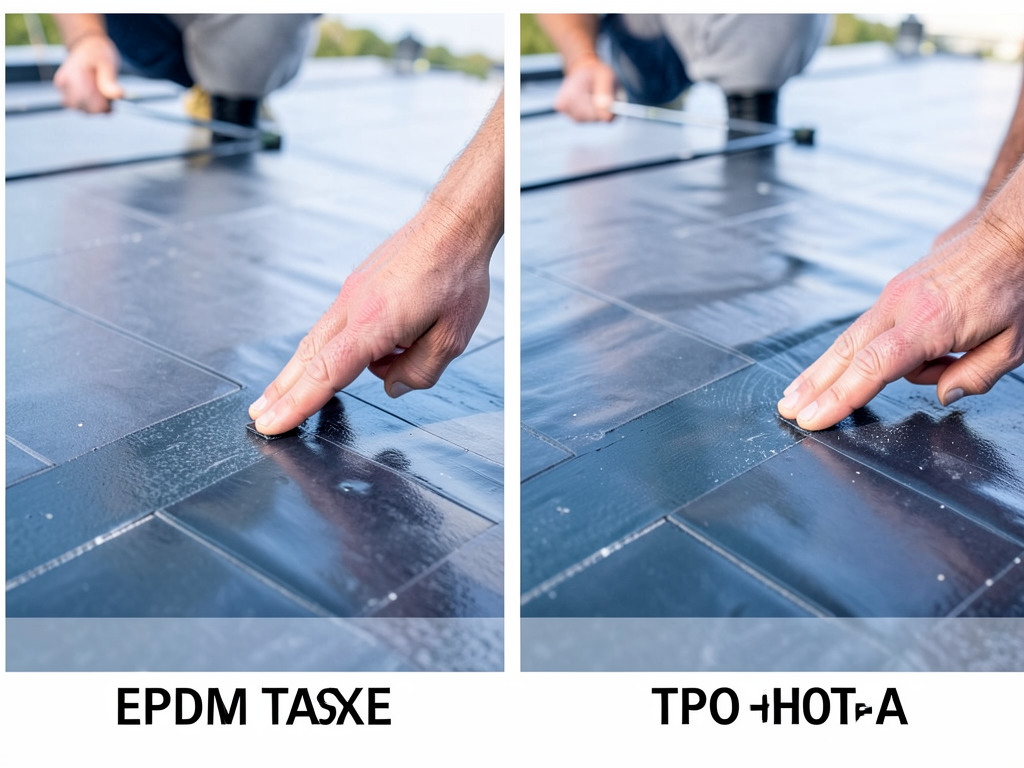
Key Difference: EPDM uses adhesives and seam tape for assembly, while TPO creates permanent molecular bonds through hot-air welding. This fundamental difference affects durability, installation speed, and long-term performance in Chicago’s climate.
Side-by-side comparison of EPDM seam tape application versus TPO hot-air welded seam on a Chicago commercial roof
Durability in the Chicago Climate: Freeze-Thaw Performance
West Ridge’s freeze-thaw cycles create unique stress patterns on roofing membranes. When temperatures fluctuate rapidly, materials expand and contract at different rates. EPDM’s rubber composition allows for greater flexibility, stretching up to 300% of its original size without damage. Roofing Berwyn.
TPO’s thermoplastic structure provides excellent dimensional stability but less elongation capacity. However, TPO’s heat-welded seams create monolithic sheets that resist separation better than EPDM’s taped joints during extreme temperature swings.
Chicago Building Code Requirement: Section 15-16-610 mandates minimum 45-mil thickness for commercial low-slope roofs in Cook County. Both materials meet this standard, but TPO’s reinforced scrim provides superior puncture resistance against urban debris and hail impacts common in West Ridge.
The National Roofing Contractors Association reports that properly installed TPO systems in Chicago’s climate last 25-30 years, while EPDM typically provides 20-25 years of service life. The five-year difference often justifies TPO’s higher initial cost for long-term property owners. Roofing Forest Park.
Energy Efficiency: Reflectivity vs. Heat Absorption
Energy costs significantly impact West Ridge business operations. The Chicago Energy Transformation Code requires commercial buildings to meet specific Solar Reflectance Index (SRI) values based on roof area and building height. Class 4 Impact Resistant Shingles.
White TPO achieves SRI values between 95-100, dramatically reducing heat island effects. A 2023 study by the Cool Roof Rating Council found that white TPO roofs in Chicago reduced cooling costs by an average of 22% compared to traditional dark roofing.. Read more about How to Choose a Roofing Contractor Who Actually Specializes in Chicago 2-Flats and 3-Flats.
EPDM’s black surface absorbs heat, which can benefit certain businesses. Restaurants and manufacturing facilities that require consistent interior temperatures may find EPDM’s heat retention reduces winter heating costs by 8-12% in Chicago’s climate.. Read more about How to Prepare the Roof of Your Forest Park Business for Heavy Snow Loads Before Winter Hits.
Performance Data: During July 2024’s heat wave, West Ridge buildings with white TPO roofs maintained interior temperatures 7-9 degrees cooler than adjacent buildings with black EPDM roofing. This temperature differential directly impacts employee comfort and equipment performance.
Installation Methods: Ballasted, Mechanically Attached, or Fully Adhered
Installation method selection affects both performance and cost. West Ridge’s older commercial buildings often have structural limitations that dictate installation approach.
Ballasted systems use river rock or pavers to hold the membrane in place. This method works well for buildings that cannot support mechanical fasteners or adhesives. However, ballasted systems add 10-15 pounds per square foot to roof load, requiring structural verification.
Mechanically attached systems use screws and plates to secure the membrane. This method provides excellent wind uplift resistance, critical for West Ridge buildings near Lake Michigan’s open exposure. Wind uplift ratings for mechanically attached TPO typically exceed 150 mph in Chicago conditions.
Fully adhered systems use adhesives to bond the membrane directly to the roof deck. This method creates the most stable installation but requires ideal temperature conditions between 40-90 degrees Fahrenheit for proper adhesive curing.
Local Consideration: West Ridge’s high-rise buildings adjacent to the lakefront require enhanced wind uplift ratings. The Chicago Department of Buildings mandates additional fastening patterns for buildings over 60 feet tall in Zone 3 wind areas.
Cost Comparison: Upfront Investment vs. Long-Term ROI in 2024
Material costs in Chicago vary significantly by season and supplier availability. As of April 2024, TPO membrane costs range from $0.80 to $1.20 per square foot, while EPDM costs $0.60 to $0.90 per square foot.
Installation labor represents the largest cost variable. TPO installation requires specialized hot-air welding equipment and certified technicians, increasing labor costs by 15-20% compared to EPDM installation.
Cost Breakdown Table:
| Material | Material Cost/SF | Installation Cost/SF | Total Cost/SF | Expected Lifespan |
|---|---|---|---|---|
| TPO | $1.00 | $2.50 | $3.50 | 25-30 years |
| EPDM | $0.75 | $2.00 | $2.75 | 20-25 years |
Energy savings significantly impact long-term ROI. A typical West Ridge 10,000-square-foot commercial building with white TPO roofing saves approximately $1,800 annually in cooling costs compared to black EPDM.
Maintenance costs also differ between materials. TPO requires professional seam inspection every 3-5 years, while EPDM needs more frequent seam tape replacement and adhesive checks every 2-3 years. Extending the Life of Your Flat Roof in Hyde Park with Professional Coating.
Maintenance Requirements and Lifespan Expectancy
Chicago’s harsh winters create specific maintenance needs for both materials. Ice dam formation can cause water backup, testing seam integrity and membrane adhesion.
TPO maintenance focuses on seam inspection and weld integrity. The material’s heat-welded seams rarely fail when properly installed, but UV exposure can degrade the membrane surface over time. Annual cleaning with appropriate solvents prevents dirt accumulation that reduces reflectivity.
EPDM requires seam tape inspection and potential replacement every 5-7 years. The material’s rubber composition resists UV damage but can develop surface cracks in extreme temperature fluctuations. Chicago’s freeze-thaw cycles accelerate this deterioration in unprotected areas.
Diagnostic Test: The screwdriver test reveals membrane integrity. Press a screwdriver into the membrane surface. TPO resists penetration with minimal deflection, while EPDM shows more flexibility and potential for puncture damage under concentrated pressure.
West Ridge businesses should schedule professional inspections twice annually: once in spring after winter damage assessment, and again in fall before snow season. Early detection of membrane issues prevents costly interior damage and business interruption.
The Verdict: Choosing Based on Your Building Type
Office buildings and retail spaces in West Ridge benefit most from white TPO roofing. The energy savings, durability, and modern appearance justify the higher initial investment. Buildings over 10,000 square feet see the fastest ROI with TPO’s cooling efficiency.
Warehouses and manufacturing facilities often choose EPDM for its cost-effectiveness and heat retention benefits. The material’s flexibility accommodates rooftop equipment movement and vibration without compromising integrity.
Restaurants and food service businesses should consider TPO’s superior chemical resistance and ease of cleaning. Grease and oil spills that would damage EPDM simply wipe off TPO’s non-porous surface.
Final Recommendation: For most West Ridge small businesses, white TPO provides the best long-term value. The material’s energy efficiency, durability, and low maintenance requirements outweigh the higher upfront cost. However, businesses with specific heating needs or budget constraints may find EPDM’s performance adequate for their requirements.
Before making your final decision, consult with a Chicago-licensed roofing contractor who understands West Ridge’s specific building codes and climate challenges. They can assess your building’s structure, energy needs, and budget to recommend the optimal solution.
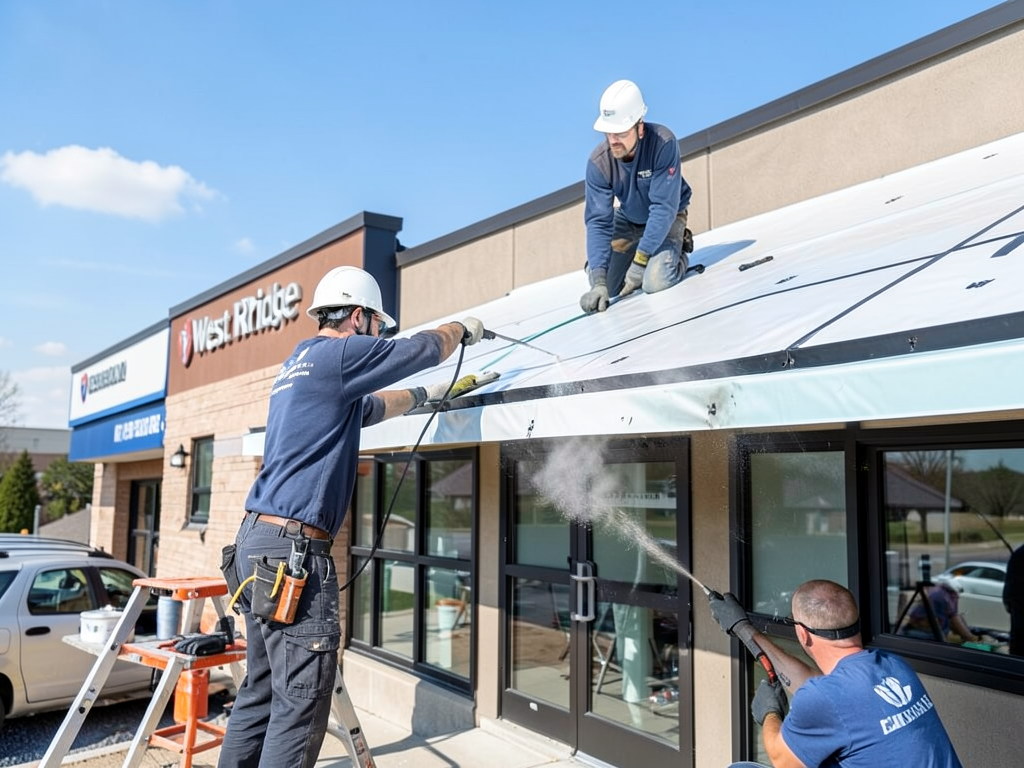
Professional roofing crew installing TPO membrane on a West Ridge commercial building, demonstrating hot-air welding technique
Frequently Asked Questions
How long does a commercial flat roof last in Chicago?
Commercial flat roofs in Chicago typically last 20-30 years depending on material quality, installation, and maintenance. TPO systems often reach 25-30 years, while EPDM systems provide 20-25 years of service life in Chicago’s climate.
What building permits are required for commercial roofing in West Ridge?
Commercial roofing in West Ridge requires permits from the Chicago Department of Buildings. Section 15-16-610 of the Chicago Building Code mandates specific thickness requirements, wind uplift calculations, and energy compliance documentation for all commercial low-slope roofing projects.
Can I install a new roof over my existing flat roof?
Roof recover (installing over existing roofing) is permitted in Chicago under specific conditions. The existing roof must be in good condition, have only one layer, and meet current code requirements. A professional inspection determines if recover installation is appropriate for your building.
How much does commercial flat roof replacement cost in Chicago?
Commercial flat roof replacement in Chicago ranges from $3.50 to $7.00 per square foot depending on material selection, building height, and installation complexity. TPO systems typically cost $3.50 to $5.00 per square foot, while EPDM systems range from $3.00 to $4.50 per square foot.
What maintenance does a commercial flat roof need?
Commercial flat roofs require bi-annual professional inspections, debris removal, seam inspection, and drainage system maintenance. Chicago’s climate necessitates additional winter preparation, including snow load assessment and ice dam prevention measures to protect membrane integrity.
Thermal imaging scan of commercial roof showing heat loss patterns, used to identify insulation issues and energy efficiency opportunities
Ready to Upgrade Your West Ridge Business Roof?
Don’t wait for the next Chicago storm to discover your roof can’t handle the pressure. Our team has installed over 500 commercial roofs in West Ridge and surrounding neighborhoods since 2010. We understand the unique challenges Lake Michigan weather creates for local businesses.
Call (773) 599-7055 today to schedule your free commercial roof assessment. We’ll evaluate your building’s specific needs, provide detailed cost comparisons, and help you make the right choice between EPDM and TPO for your business’s future.
Pick up the phone and call (773) 599-7055 before the next freeze-thaw cycle damages your existing roof. Your business deserves a roof that performs as hard as you do.
You may also find this helpful. Comparing Modified Bitumen and TPO for Industrial Buildings in McKinley Park.
{
“@context”: “https://schema.org”,
“@type”: “BlogPosting”,
“headline”: “Comparing EPDM and TPO for Small Business Owners in West Ridge”,
“description”: “EPDM vs TPO flat roofing comparison for West Ridge businesses. Learn which membrane performs better in Chicago’s freeze-thaw cycles, wind uplift, and energy codes.”,
“wordCount”: 1677,
“datePublished”: “2026-04-27T11:55:00.000Z”,
“dateModified”: “2026-04-27T11:55:00.000Z”,
“inLanguage”: “en-US”,
“mainEntityOfPage”: {
“@type”: “WebPage”,
“@id”: “https://patriotroofingchicago.com”
},
“publisher”: {
“@type”: “LocalBusiness”,
“name”: “Patriot Roofing Chicago”,
“url”: “https://patriotroofingchicago.com”
},
“author”: {
“@type”: “Organization”,
“name”: “Patriot Roofing Chicago”,
“url”: “https://patriotroofingchicago.com”
},
“image”: {
“@type”: “ImageObject”,
“url”: “https://patriotroofingchicago.com/wp-content/uploads/2026/03/comparing-epdm-and-tpo-for-small-business-owners-i-1.png”
}
}
{
“@context”: “https://schema.org”,
“@type”: “RoofingContractor”,
“name”: “Patriot Roofing Chicago”,
“url”: “https://patriotroofingchicago.com”,
“address”: {
“@type”: “PostalAddress”,
“addressLocality”: “Chicago”
},
“areaServed”: {
“@type”: “City”,
“name”: “Chicago”
}
}
{
“@context”: “https://schema.org”,
“@type”: “FAQPage”,
“mainEntity”: [
{
“@type”: “Question”,
“name”: “How long does a commercial flat roof last in Chicago?”,
“acceptedAnswer”: {
“@type”: “Answer”,
“text”: “Commercial flat roofs in Chicago typically last 20-30 years depending on material quality, installation, and maintenance. TPO systems often reach 25-30 years, while EPDM systems provide 20-25 years of service life in Chicago’s climate.”
}
},
{
“@type”: “Question”,
“name”: “What building permits are required for commercial roofing in West Ridge?”,
“acceptedAnswer”: {
“@type”: “Answer”,
“text”: “Commercial roofing in West Ridge requires permits from the Chicago Department of Buildings. Section 15-16-610 of the Chicago Building Code mandates specific thickness requirements, wind uplift calculations, and energy compliance documentation for all commercial low-slope roofing projects.”
}
},
{
“@type”: “Question”,
“name”: “Can I install a new roof over my existing flat roof?”,
“acceptedAnswer”: {
“@type”: “Answer”,
“text”: “Roof recover (installing over existing roofing) is permitted in Chicago under specific conditions. The existing roof must be in good condition, have only one layer, and meet current code requirements. A professional inspection determines if recover installation is appropriate for your building.”
}
},
{
“@type”: “Question”,
“name”: “How much does commercial flat roof replacement cost in Chicago?”,
“acceptedAnswer”: {
“@type”: “Answer”,
“text”: “Commercial flat roof replacement in Chicago ranges from $3.50 to $7.00 per square foot depending on material selection, building height, and installation complexity. TPO systems typically cost $3.50 to $5.00 per square foot, while EPDM systems range from $3.00 to $4.50 per square foot.”
}
},
{
“@type”: “Question”,
“name”: “What maintenance does a commercial flat roof need?”,
“acceptedAnswer”: {
“@type”: “Answer”,
“text”: “Commercial flat roofs require bi-annual professional inspections, debris removal, seam inspection, and drainage system maintenance. Chicago’s climate necessitates additional winter preparation, including snow load assessment and ice dam prevention measures to protect membrane integrity.”
}
},
{
“@type”: “Question”,
“name”: “Ready to Upgrade Your West Ridge Business Roof?”,
“acceptedAnswer”: {
“@type”: “Answer”,
“text”: “Don’t wait for the next Chicago storm to discover your roof can’t handle the pressure. Our team has installed over 500 commercial roofs in West Ridge and surrounding neighborhoods since 2010. We understand the unique challenges Lake Michigan weather creates for local businesses.”
}
}
]
}
{
“@context”: “https://schema.org”,
“@type”: “BreadcrumbList”,
“itemListElement”: [
{
“@type”: “ListItem”,
“position”: 1,
“name”: “Home”,
“item”: “https://patriotroofingchicago.com”
},
{
“@type”: “ListItem”,
“position”: 2,
“name”: “Blog”,
“item”: “https://patriotroofingchicago.com/blog”
},
{
“@type”: “ListItem”,
“position”: 3,
“name”: “Comparing EPDM and TPO for Small Business Owners in West Ridge”
}
]
}
{
“@context”: “https://schema.org”,
“@type”: “Service”,
“serviceType”: “Roofing”,
“provider”: {
“@type”: “LocalBusiness”,
“name”: “Patriot Roofing Chicago”,
“url”: “https://patriotroofingchicago.com”
},
“areaServed”: {
“@type”: “City”,
“name”: “Chicago”
},
“description”: “EPDM vs TPO flat roofing comparison for West Ridge businesses. Learn which membrane performs better in Chicago’s freeze-thaw cycles, wind uplift, and energy codes.”
}